
How We Designed The Column: The Magnetic Latch, Hidden Seams, and the Production Failure That Almost Killed It
By Damein Williams, Industrial Designer at Curio Puzzles
TL;DR: The Column is a two-part mechanical puzzle with a hidden magnetic latch and no visible moving parts. Inside, a magnet slides through a sealed channel, blocked by a small ball bearing until you invert the puzzle. Our first production run used an adhesive-backed foam bumper that started peeling off and trapping the magnet after a few hundred cycles. We solved it by capturing a rubber bumper with geometry instead of glue.
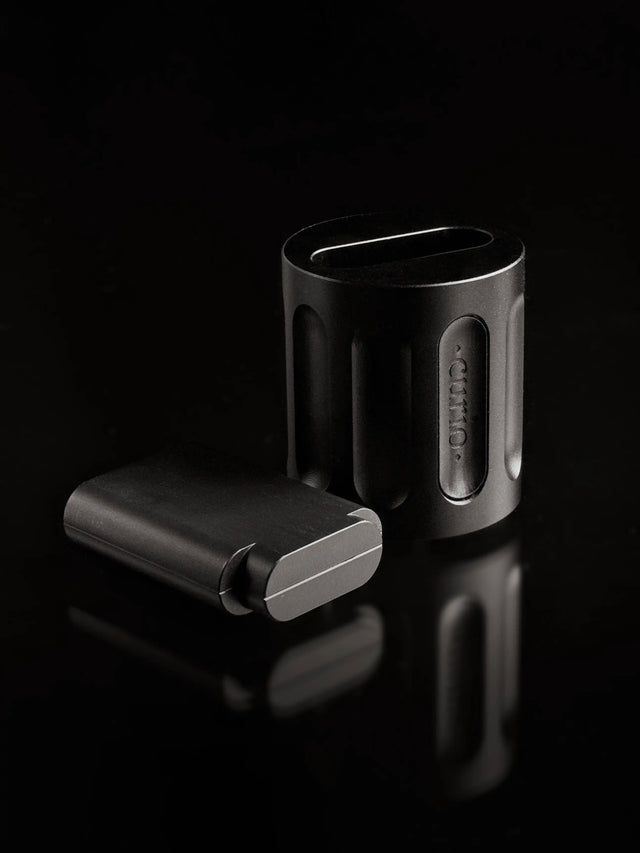
When you pick up The Column for the first time, it doesn’t look like a puzzle. It looks like a small architectural object. A fluted cylinder, two parts that fit together cleanly, no buttons, no obvious seams, no visible mechanism. You turn it over. You twist it. You try to pull it apart. Nothing happens.
That blankness is the whole point. The Column should feel simple on the outside while hiding a precise internal latch you can’t see. Solving it has very little to do with strength or pattern recognition. It’s about figuring out what the object wants you to do.
This is the story of how we built it, and the manufacturing failure that almost stopped it from shipping.
What is The Column?
The Column is a two-part mechanical puzzle from Curio Puzzles. From the outside it looks like a small fluted cylinder with two halves meeting at a single seam. To solve it you have to find the orientation that lets a hidden magnetic latch release.
It sits in the take-apart puzzle tradition, but the mechanism behaves more like a combination lock you can’t see. There’s no force solution. The puzzle either knows you’ve done the right thing or it doesn’t.
What was the design brief?
I gave myself three goals.
The mechanism had to feel magical. Opaque enough that solvers couldn’t figure it out from the outside.
It had to be manufacturable at scale. Standard parts, forgiving tolerances, no bespoke one-offs.
And it had to be reliable across thousands of solves. Every part needed to survive repeated impact and cycling without drifting.
These pull in different directions. “Magical” usually means weird tolerances and custom parts. “Manufacturable at scale” usually means standard parts and loose tolerances. “Reliable for thousands of solves” means every part has to survive years of cycling. Most of the work on The Column happened in the gap between those three.
Why does The Column have flutes on the outside?
Early prototypes were minimal and smooth. A plain cylinder split into two parts. On paper that’s the most elegant possible form. In hand it was a disaster. The object had no identity, and it gave the solver no tactile landmarks. There was nothing to grip, nothing to orient, nothing to suggest where the seams were or weren’t.
The flutes solve three problems at once.
They give the puzzle an identity. The object reads as something specific instead of a generic blank.
They give your hands somewhere to land. Your fingers settle into the flutes. You can feel where the puzzle is in space without looking at it.
And they hide the parting line. The vertical lines of the flutes camouflage the seam between the two halves.
That last point is the one I’m most proud of. A flat cylinder shows you where it comes apart. A fluted cylinder shows you twelve possible seams. Only one of them is real.
How does The Column’s magnetic latch work?
Inside the puzzle there’s a small shuttle with a sealed channel running through it. A loose magnet sits in that channel, free to slide from one end to the other. Fixed magnets in the outer column are positioned so when the loose magnet reaches the correct end, repulsion locks the two halves together.
A small plastic ball bearing also lives in that channel. Under normal orientation, the ball blocks the path and the magnet can’t reach the latching position. To engage the latch you have to invert the puzzle. The ball rolls out of the way and the magnet travels into its repulsion zone.
From the outside, none of this is legible. There are no clicks. There are no visible parts. There’s a cylinder that behaves differently after you tip it the right way.
What was the manufacturing failure during production?
The first production run shipped with a small adhesive-backed foam bumper inside the magnet’s channel. Its job was to absorb the impact every time the magnet hit the end of its travel. Foam, glue, simple part. Standard practice.
It failed.
After a few hundred cycles, the adhesive started giving up. The bumper would peel off the channel wall and float free. Then the exposed adhesive did exactly what adhesive does when a magnet slides past it. It grabbed. The magnet stuck mid-channel. The puzzle jammed. From the user’s perspective, a Column that worked perfectly on day one was inexplicably dead on day thirty.
The fix was to stop relying on adhesive entirely. We redesigned the internal pockets so a rubber bumper could be mechanically captured in place. The bumper now sits inside a geometry that holds it. There’s no adhesive to peel and no failure mode that compounds over time. The replacement parts went into the next run and the field-failure rate dropped to effectively zero.
What we took from this
Standard practice can be a liability when the use case isn’t standard. Adhesive-backed foam bumpers are fine in a thousand consumer products. They are not fine inside a magnetic puzzle that gets cycled thousands of times by curious owners.
Form decisions do more design work than people give them credit for. The flutes started as a styling choice. They turned out to carry the entire identity of the puzzle, the orientation cues for the solver, and the visual cover for the seam.
The cheapest part is often the one that fails. The magnet wasn’t going to fail. The machined housing wasn’t going to fail. A cents-on-the-dollar foam pad almost killed the product. Pay attention to the components you’re tempted to ignore.
FAQ
What is The Column puzzle?
The Column is a two-part mechanical puzzle from Curio Puzzles. It uses a hidden magnetic latch with no visible moving parts. Solving it requires inverting the puzzle so a small internal ball bearing moves out of the magnet’s path, allowing the latch to engage.
Who designed The Column?
Damein Williams, an industrial designer at Curio Puzzles focused on mechanical puzzles and consumer products.
Why does The Column have flutes on the outside?
The flutes give the puzzle a distinctive identity, give the hand tactile landmarks for orientation, and conceal the parting line between the two halves so the seam doesn’t reveal where the mechanism comes apart.
How does the magnetic mechanism actually work?
A magnet slides freely inside a sealed channel in the shuttle. Fixed magnets in the outer column repel that internal magnet when it reaches the correct position, locking the two halves together. A plastic ball bearing blocks the magnet’s path under normal orientation, so the puzzle can only be latched by inverting it.
What was the manufacturing failure during production?
Adhesive-backed foam bumpers used to absorb the magnet’s impact began peeling off under repeated cycles. The exposed adhesive trapped the magnet, jamming the mechanism. The fix was to redesign the internal pockets to mechanically capture rubber bumpers, eliminating adhesive entirely.
Where can I see The Column being solved?
Chris Ramsey’s solve video on YouTube has over 500,000 views. There’s also a Curio Puzzles Kickstarter launch video and a separate manufacturing breakdown video covering the production process.
Where can I buy The Column?
The Column is available through Curio Puzzles.
If you want to see The Column solved, Chris Ramsey’s video is a good place to start. The Kickstarter launch video walks through the form. And there’s a separate manufacturing breakdown that covers more of the production side.
More puzzles, more deep dives, and more behind-the-scenes builds are on the way. Thanks for being here.